
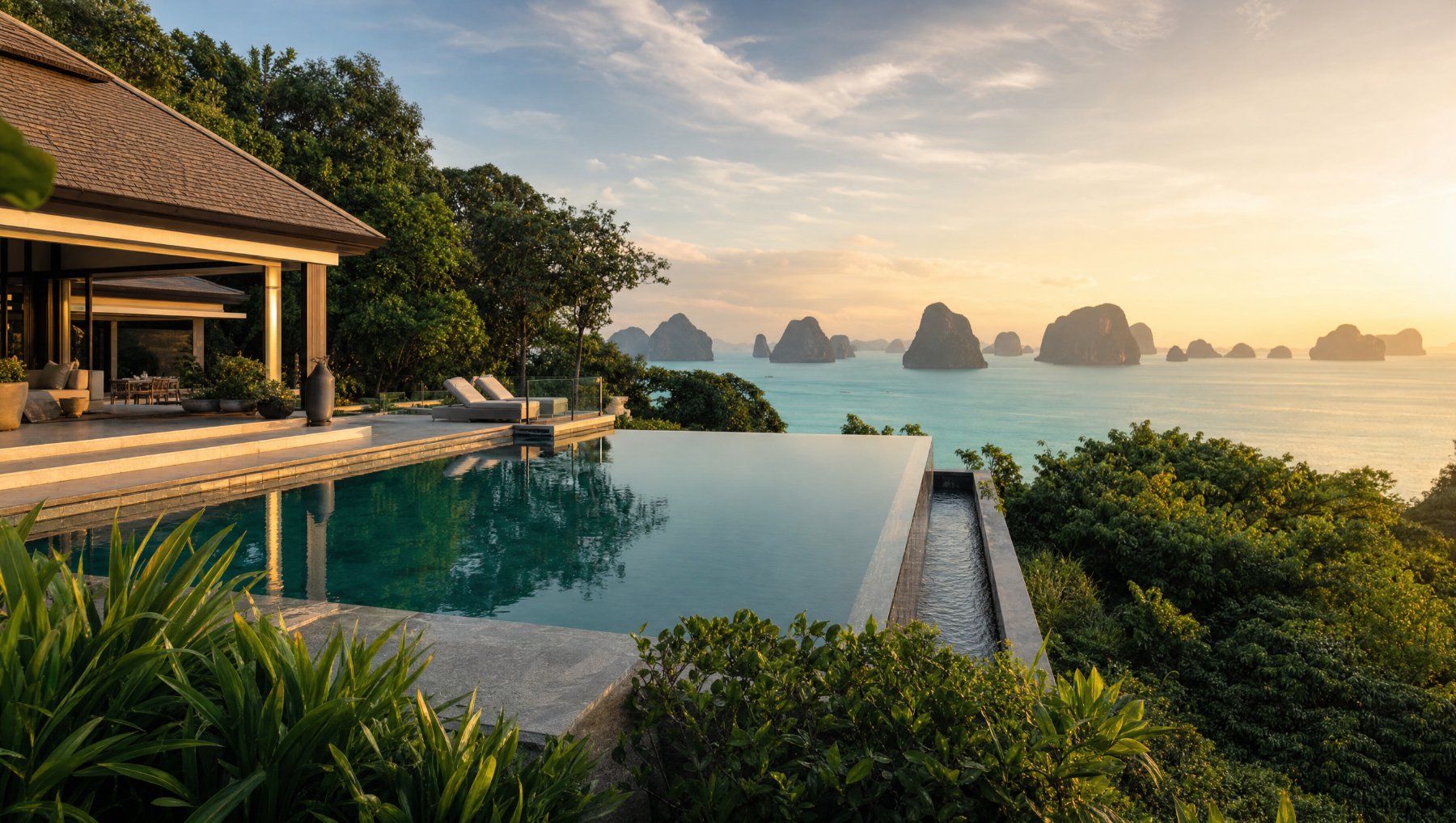
Offering luxury properties in prime locations across Phuket
Phuket is Asia’s leading resort island — beaches, diving, marinas, golf, and a hotel and restaurant scene that supports year-round demand rather than a short season. Planning rules and height restrictions keep development low-density, which has protected it from the overbuilding that damaged other Asian resort markets.
49%
Foreign freehold quota
30 yrs
Maximum registered lease
~5.6%
Avg gross yield, Q3 2026
3.6–4.1%
Realistic net yield
How foreign ownership actually works
This is the part that matters, and it is routinely glossed over by people selling.
Condominiums. A foreigner can own a condominium unit outright, freehold, in their own name — but only within the 49% foreign quota of a registered condominium building. Once the quota is full, remaining units are leasehold only. Freehold registration also requires the purchase funds to be remitted into Thailand in foreign currency, evidenced by a Foreign Exchange Transaction (FET) form from the receiving Thai bank. Without it the Land Office will not register foreign freehold.
Land cannot be owned by a foreign individual. Houses and villas are therefore structured differently, and the structure matters more than the property.
A caution on “30 + 30 + 30” leases
Thai law caps a registered lease at 30 years. Structures marketed as 30 years “with two guaranteed renewals” — presented to buyers as effectively freehold — do not carry the weight they are given.
In Supreme Court Decision No. 4655/2566, reported in a Phuket case in March 2025, the court held that a pre-agreed renewal is a personal contractual promise that does not bind an heir or a subsequent purchaser of the land. The tenant was ordered to vacate and damages were awarded.
Treat a 30-year lease as a 30-year lease, and price it accordingly. A better-protected route for a villa separates the assets: a registered lease of the land, plus registered superficies giving foreign freehold ownership of the building itself.
Speak to an advisor
Structure matters more than the property here. We will walk through it, and its limits, before you commit.
Pricing and realistic returns
Mid-market Phuket condominium pricing runs roughly USD 2,500–3,600 per m², with city-centre, beachfront and branded-residence stock materially higher — above USD 5,400 per m². Prices are baht-denominated, so the dollar figure moves on currency alone.
Measured gross rental yields average around 5.6% across Phuket — approximately 6.1% for one-bedroom units, 5.7% for two-bedroom and 5.0% for three-bedroom (Global Property Guide, Q3 2026). Yields fall as unit value rises, so premium stock earns less income, not more. Net of management fees, common-area charges, maintenance, vacancy and Thai rental income tax, realistic net yields run roughly 3.6–4.1%.
On “guaranteed” returns. Headline figures of 6–7% quoted by managed rental programmes are gross, contractual for a fixed term only, and generally funded from a purchase price set high enough to absorb the guarantee. Ask what the unit earns after the guarantee period ends — that is the number that matters.
Current conditions are soft, and we would rather say so: foreign condominium transfers fell 17.3% year on year in Q1 2026, foreign tourist arrivals declined 7.2% across 2025, and Thai rent inflation was 0.29% year on year in June 2026.
Frequently asked questions
A condominium unit, yes — freehold, in your own name, within the building’s 49% foreign quota, with funds remitted in foreign currency and an FET form issued. Land cannot be owned by a foreign individual; villas are structured through a registered lease, often combined with registered superficies over the building.
Less safe than they are usually presented. A registered lease is capped at 30 years, and the Thai Supreme Court has held that pre-agreed renewals do not bind an heir or a subsequent purchaser of the land. Structure and price on the basis of 30 years.
Around 5.6% gross on average, falling as unit value rises, and roughly 3.6–4.1% net after costs and Thai rental tax. Advertised 6–7% figures are typically gross guarantees for a fixed term, priced into the purchase.
No. Property ownership confers no residency or visa in Thailand. Long-stay visa options exist and are entirely separate from a purchase.
Considering Phuket?
The market is soft and the lease structures are widely misrepresented. That is exactly when advice is worth having.